

Rising bond yields, mounting government debt and persistent inflation have raised concerns among investors in recent months. Market strategist Ed Yardeni recently joined our Co-CEO Pat Sommerville for a special webcast to discuss what has been driving yields higher and if investors need to be worried about the “Bond Vigilantes” returning.
Here are the key takeaways from that conversation.
The Bond Vigilantes: A Brief History
- Yardeni coined the term in 1983 to describe bond investors who demand higher yields in response to concerns about excessive government borrowing and inflationary policies. Having suffered significant losses during the inflationary 1970s, bond investors began pushing back against such policies by demanding higher yields. The term has since become a fixture in financial markets, so much so that Yardeni jokes he should have copyrighted it. “If I just had 10 cents every time it’s used, I could probably retire by now,” he said.
- The Bond Vigilantes remained influential throughout the 1990s. Yardeni recalled how the Clinton administration was conscious of the need to maintain fiscal discipline to avoid a backlash from the bond market. By the end of the decade, the U.S. was running a fiscal surplus, although deficits returned and expanded in the years following 9/11.
- Following the Global Financial Crisis and through the COVID-19 pandemic, central banks suppressed bond yields through quantitative easing and near-zero interest rates in response to concerns about deflation and weak economic growth. Yardeni described this period as central banks having “rigged” the bond market, effectively silencing the Bond Vigilantes and limiting their influence over fiscal policy.
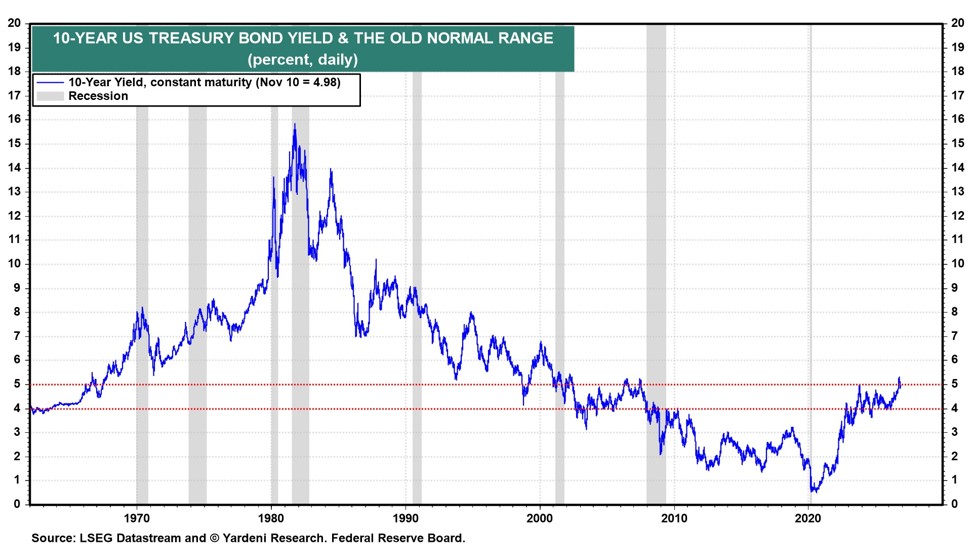
Chart: Yardeni considers 10-year U.S. Treasury yields of 4%–5% to be within a normal historical range and a sign of a healthy economy, similar to levels seen in the 1960s and before the Global Financial Crisis.
The Good, the Bad and the Ugly: What’s Driving Bond Yields Higher?
- Since the start of the pandemic, U.S. 10-year Treasury yields have gone from less than 1% to over 5% at their peak. Yardeni believes stronger-than-expected economic growth is an important driver of the increased yields, which he views as a positive development.
- However, he also identified three other factors potentially contributing to upward pressure on yields: inflation concerns relating to rising oil prices amid conflict in the Middle East, the potential unwinding of the yen carry trade and concerns about government debt.
- Yardeni believes rising bond yields driven by inflation concerns could create buying opportunities in the bond market. He expects productivity gains from technology to moderate Unit Labor Cost (ULC) inflation, potentially easing inflationary pressures over time.
Are the Bond Vigilantes Back? How High Is Too High?
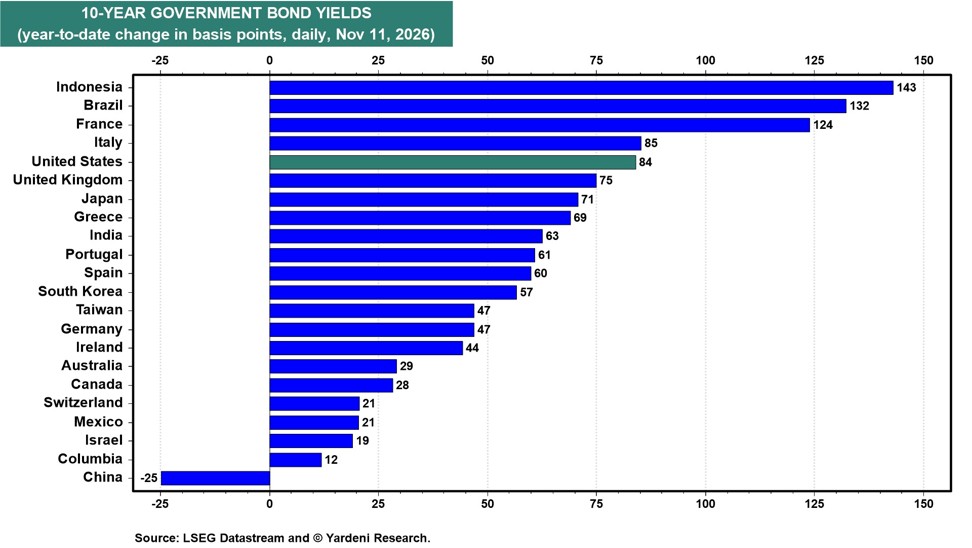
- Yardeni says the Bond Vigilantes are “on alert” in the U.S. but not on the “warpath”. He sees more evidence of their return in countries such as France and potentially Japan.
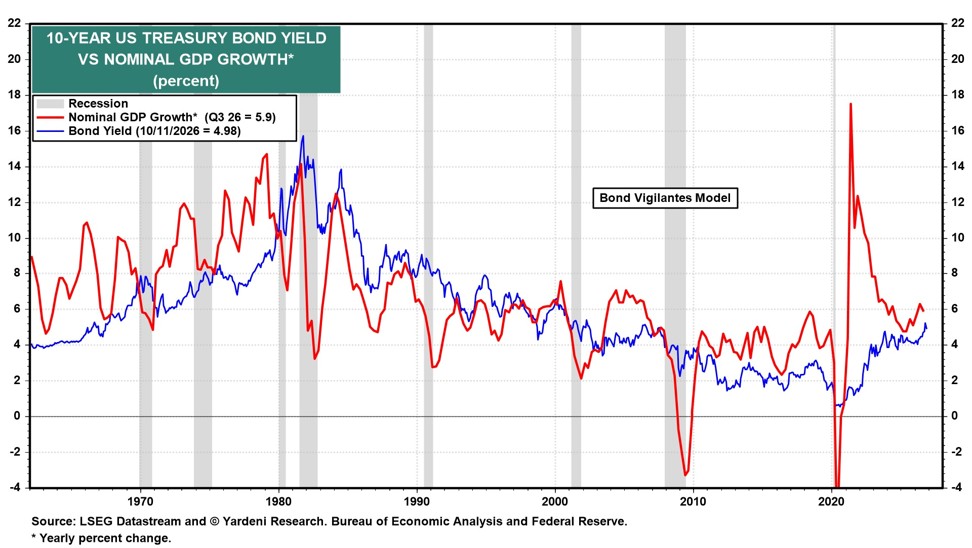
- U.S. Treasury yields remain within what Yardeni considers a normal historical range, with a 10-year yield of around 5% not particularly concerning. However, his model (see chart below) suggests that yields exceeding nominal GDP growth (5.9% in Q3 2026) could weigh on the economy, as they did in the 1980s. He cautioned that yields reaching 6%–8% could cause economic damage and increase pressure on policymakers to address fiscal challenges.
- Yardeni believes that selling pressure from the Bond Vigilantes can be countered by other players like individual investors, foreign investors, institutional domestic investors, the U.S. Treasury etc. With substantial global wealth seeking diversified investments, U.S. Treasuries remain an important source of safety, particularly during periods of uncertainty, as they were after the midterm elections.
- Yardeni suggested that Scott Bessent, the Treasury Secretary, can always counter selling pressure by pulling out the “bazooka” and buy substantially more long-dated Treasury bonds financed through the issuance of short-term Treasury bills.
Quote: “People have been saying that bond yields and other interest rates are going to be higher for longer. I would say that they’re going to be normal for longer. We’re back to normal. We’re back to where bond yields and short-term rates should be in an economy that’s doing well and still has an inflation problem.”
Chart: Yardeni’s Bond Vigilantes Model compares the 10-year U.S. Treasury yield with nominal GDP growth (economic growth including inflation). In the 1980s, U.S. 10-year treasury bond yields rose above nominal GDP growth as investors demanded higher returns, contributing to economic slowdowns. Yardeni views a return to this pattern as a warning sign that the Bond Vigilantes could be putting the brakes on the economy. With Treasury yields currently below nominal GDP growth, he is not yet sounding the alarm.
Interest Rates and Inflation
- Yardeni expects a 50-basis-point interest rate hike at the December meeting after the Fed held interest rates steady at 3.75% to 4% in October. This is because inflation is not close to the 2% Fed target.
- He believes that if oil prices continue to fall, another month or two of hotter-than-expected inflation could be followed by some moderation going into the new year.
U.S. Debt Fears and Political Gridlock
- Yardeni says investors like Ray Dalio warning about an impending U.S. debt crisis could be right and their pessimism is warranted to a certain extent because deficits have been widening even outside of recessions. Interest costs have also been spiraling upwards. He criticizes policymakers for “slamming on the gas pedal” on the fiscal and monetary side during the pandemic and contributing to the inflation problem.
- The results of the midterm elections are “somewhat concerning” because the increased likelihood of political gridlock could hamper attempts to pass legislation to deal with financial emergencies.
- He counters the debt pessimism by pointing out that “debt doom and gloom” has been around for a while and highlighting the strength of the U.S. economy with all-time highs for real GDP, consumer spending and the S&P 500 index. He mentioned he has two alarmist books from the 1980s on his bookshelf warning of an impending debt crisis, including “The Coming Debt Bomb” by James Dale Davidson and “Living Beyond Our Means” by Peter G. Peterson. Decades later, the warnings continue, but a U.S. debt crisis has yet to materialize.
Quote: “Everybody’s worrying that the debt crisis is imminent, but it’s been imminent for a while. And maybe I’ve been doing this for too long, I’m too jaded. Maybe we are about to see a debt crisis. But I don’t think so.”
Global Contagion Fears
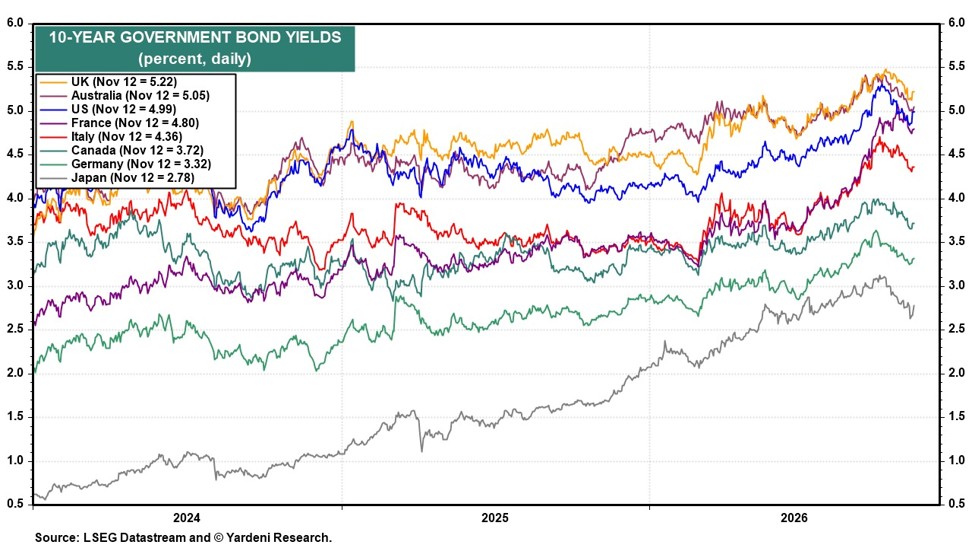
- There’s been a coordinated upward trend for bond yields globally the last few years. (see chart below) Yardeni thinks in the event of debt crises in countries like France and the UK, the problem will largely stay within Europe without much spillover into North America.
AI and Pickier Bond Investors
- Yardeni views the bond market’s growing scrutiny of AI-related borrowing as a positive development. Investors are becoming more selective about the credit quality of companies financing the AI buildout, which he believes had been moving too quickly.
- Beyond the physical constraints like electricity and water, the AI boom is also facing financial constraints from more investor scrutiny and political constraints on data centre expansion.
- Yardeni doesn’t think these are roadblocks for the AI trade but rather speed bumps.
Quote: “I think it’s great that the Bond Vigilantes stopped focusing just on the government bonds and started to really spend some more time focusing on the credit quality of AI bonds.”
Trivia
Apple, Google (Alphabet), OpenAI, Twitter and Nvidia. Which of these companies did not have a founder or co-founder who was also a “boomerang CEO”?
Hint: A boomerang CEO is someone who leaves the CEO role, willingly or unwillingly, and later returns to it.
Answer: Apple. Despite making arguably the most famous corporate comeback in history, Steve Jobs was never Apple’s CEO before leaving in 1985. He was its co-founder and chairman. He only became CEO after returning in 1997.
Disclaimers:
The information provided by Hamilton ETFs includes data obtained from third-party sources. While we strive to ensure the accuracy and completeness of such data, we make no representations or warranties, either express or implied, regarding the accuracy, reliability, timeliness, or completeness of such third-party information.
This material is provided for informational purposes only. The information contained herein does not constitute, and should not be construed as, investment, tax, or legal advice. Specific investment decisions and strategies should be assessed in the context of an individual’s personal financial objectives, and professional advice should be sought for any particular circumstance.